
Follow the cash.
Finances starts with one question. Does the spend match the cash, and does it match the story the board told? It does not start on a chart with the question buried under it.
A single total is how a theft hides. The job, the invoice, and the person who signed have to stay apart. Nothing on this desk is one number with the parts missing.
What came in
What came in is the money that arrived. Monthly dues sit against the budget for those dues. The special assessment is on the page, and it is not pretending to be an operating line.
Dues and a special assessment are not the same dollar. One cannot be used to explain the other. Income is what has come in. The dues are what the owners were supposed to pay.
Budget versus actual
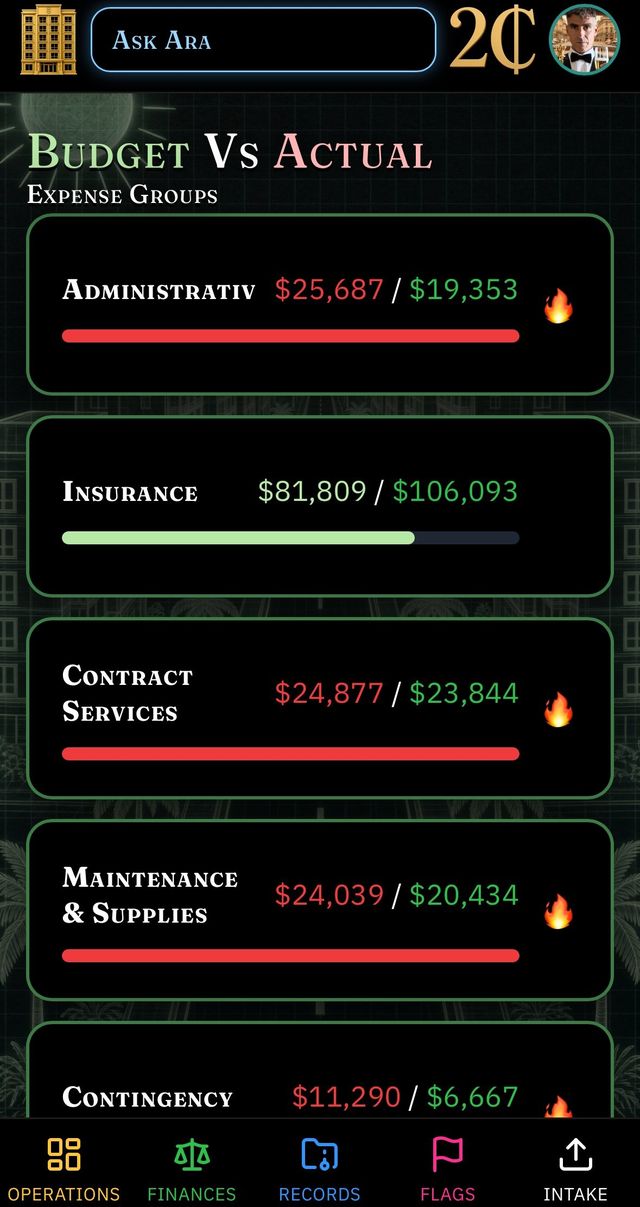
The operating budget is the plan the board signed for the year. Not a guess. Not last month’s spend. Expense groups are that plan taken apart. What the budget allowed, next to what was spent.
A group that has gone past its line shows it. A group that is still inside shows that too. The total at the top of the building is not allowed to hide a group that already broke. Electric, water, and sewer each stand on their own line. If the electric bill is the thing that ran past, the electric line is the thing that says so.
A special assessment
The special assessment is not one lump. Each job is on its own line. Whether it was signed. The company on that line. The amount. An owner can see the work, who was hired to do it, and what that line was allowed to cost.
A single assessment total is not allowed to hide the job. The contractor is on the card. The price of the contract stays with the name. Open it, and the contract is the paper behind the name.
The lines in red
Red is already past the line. Green is still inside the budget or the contract. A red figure is not a mood. It is past a number the board already wrote down, or past a price a contract already named. You can see which one it broke.
Cash in the banks is the money still in the accounts. Spent over is the cash already out past a budget line or a signed contract. These are the first answers. They are not a decoration.
The audit
The audit stays on the finances desk, and cash in the banks stays on that page with it. The audit is not a PDF in a folder you have to remember. The opinion and the accounts can be read together.
The paper behind a number is the official record. If that page was never filed, the gap stays visible. The money and the missing page are the same question.